

Welcome back to Competition on the Merits! A lot has happened since last week’s column on 10 Ways President Trump can fix the very, very broken FTC. And much of it has involved issues we have analyzed here at COTM. For example:
The antitrust pressure from the apparent boycott against the Andretti-Cadillac F1 team has resulted in a settlement.
The DOJ has proposed a wild set of remedies in the Google Search case – including a government mandated divestiture of Google Chrome as well as a hodgepodge of fixes that have precious little to do with the DOJ’s theory of harm in the case. We predicted then, and now, that Judge Mehta will bar the default exclusives at issue in the case with perhaps a little fencing in relief around the edges. No more or less.
I am thankful this season for COTM readers! Please do support Competition on the Merits by subscribing, upgrading to a paid subscription, sending to colleagues.
The biggest development has been DOGE. Yes, DOGE. The Department of Government Efficiency went from from X.com meme to a brand new, if not temporary, institution in the administrative landscape. Elon Musk and Vivek Ramaswamy announced their plan in the WSJ.
The two of us will advise DOGE at every step to pursue three major kinds of reform: regulatory rescissions, administrative reductions and cost savings. We will focus particularly on driving change through executive action based on existing legislation rather than by passing new laws.
The DOGE agenda appears to be largely about a combination of moonshots for government reform combined with eliminating wasteful expenditures – perhaps with an emphasis on absurd and wasteful.
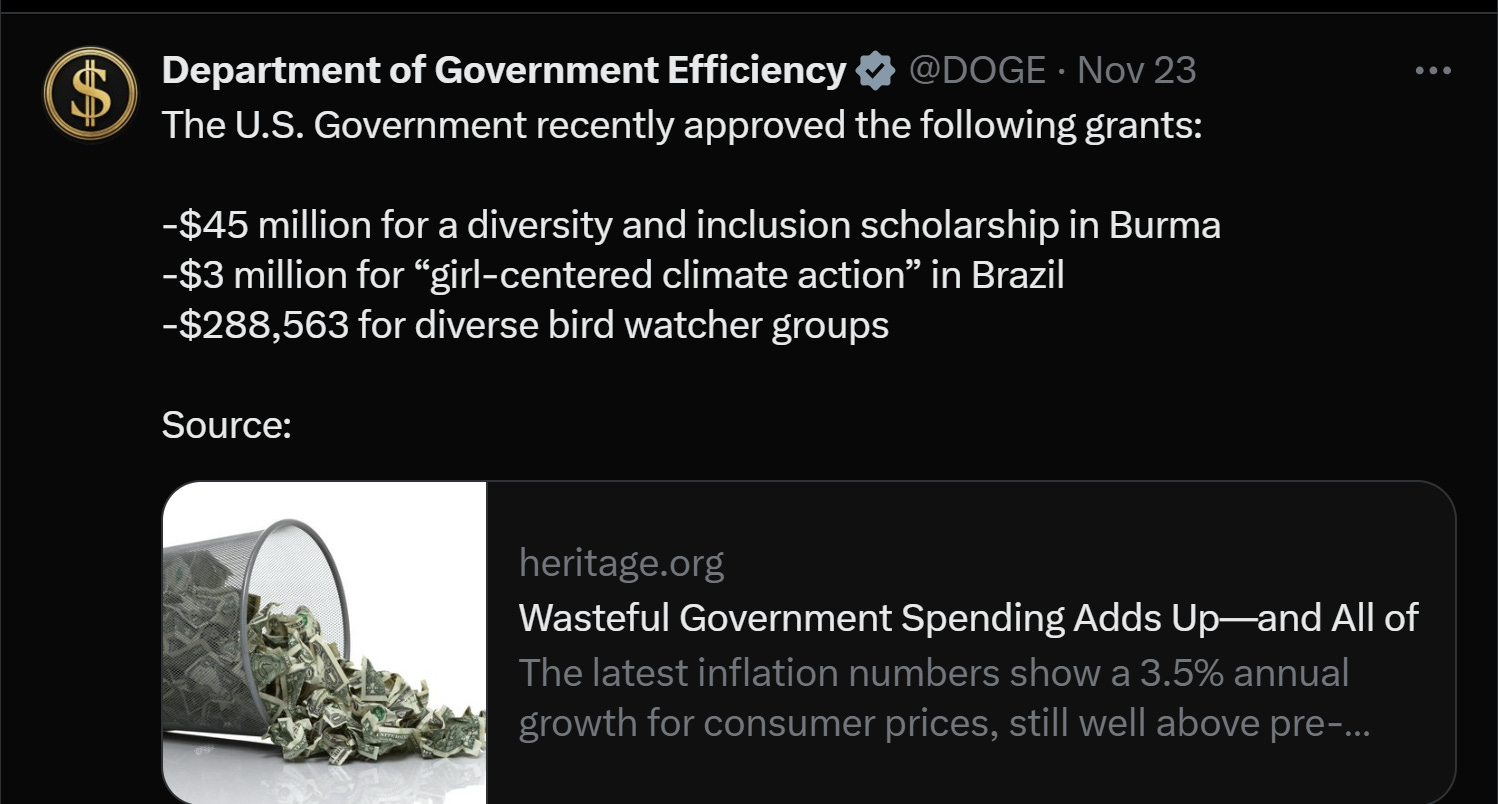
The internet is full of everyone’s favorite ideas to DOGE-ify their favorite government agency or bureaucratic institution: audit the IRS, downsize the federal government, implement a flat tax, and so forth.
Well, I don’t know anything about the IRS. But I do know about the FTC. So today’s Competition on the Merits is about DOGE-ifying the FTC. OK, DOGE-ifying is not a word. But maybe it will be in a few years. But you get the idea. Here are three big (OK, one really big and two medium) ideas for clearing up waste and saving costs at the FTC.
We might as well start with the most aggressive idea…
#1 Eliminate the FTC. Or At Least Fold Its Competition Authority Into the DOJ
Antitrust enforcement in the United States is an absolute mess. As I wrote in the Competition on the Merits column on the promise of Whole of Government Competition Policy:
Federal competition policy is a decentralized beast. Layered atop the peculiar dual jurisdiction of the FTC and DOJ at the federal level is a remarkably complex and decentralized system of competition enforcement authority distributed among myriad federal sectoral regulators, state attorneys general, and private litigants that enforce the federal antitrust laws. Competition authority is distributed broadly and generously across the federal government.
The dual federal enforcement problem generates more costs than benefits. The FTC does a lot of its damage through authorities not available to the DOJ Antitrust Division: Section 5’s Unfair Methods of Competition, abuse of administrative adjudication, attempts at competition rulemaking, and more. The “Clearance Process” that is supposed to make orderly the market division agreement between the FTC and DOJ over which agency gets which merger or conduct investigation can be a high stakes coin flip. The coin coming up “FTC” rather than “DOJ” can mean being subject to never-ending investigations and an administrative adjudication process in which the agency always wins. The other side of the coin means more efficient access to meaningful judicial review — but (at least over the past 4 years) perhaps criminal sanctions for activity that the FTC would prosecute civilly. The Clearance Process can also become a game of political football as the FTC and DOJ strategically allocate cases.
And it is not just the FTC and DOJ. It is not just that the DOJ and FTC share jurisdiction. While the bulk of federal competition authority vests in either the Antitrust Division of the DOJ or the FTC, there are over 100 sections of the U.S. Code – scattered across 24 titles – that either vest some other federal agency with responsibility for preserving competition or otherwise require the agency to take competition into consideration.
(Conveniently collected for you in an appendix, Douglas H. Ginsburg & Joshua D. Wright, Appendix of Competition Authority in the U.S. Code (Feb. 28, 2024), https://papers.ssrn.com/sol3/papers.cfm?abstract_id=4712328.) Perhaps the most well known of these is the clumsy dual allocation of competition authority in transactions involving the transfer of broadcast licenses to the FCC along with the DOJ.
All of that is to say the FTC’s redundant competition mission is not worth the trouble. The costs have long exceeded the costs of dual federal antitrust enforcement as Judge Ginsburg and I explain at length here. Many in the antitrust community agree with that assessment but respond with a shoulder shrug and say something like “sure, it does not make any sense! It’s a historical accident! But it’s OUR historical accident.” That just is not a good enough answer.
If DOGE serves as an excuse to think about our competition enforcement design problem more seriously than we have in awhile, then it is a welcome development. Indeed, proposals abound to do exactly this. Senator Lee introduced the “One Agency Act,” to solve this problem years ago. Antitrust insiders can be excused for their skepticism about the bill’s potential 4 years ago. Antitrust lawyers have been raised on the idea that the “historical accident” was here to stay. But the last four years have been quite the ride. Defenders of “independent” agencies have watched the FTC turn into (at best) a thinly veiled extension of the Executive.
To be clear, this is not about more or less antitrust enforcement. The FTC’s competition mission would simply be folded into the DOJ Antitrust Division. How? It’s really not that complicated. You just fold it in.

One way to think about this question is to ask about whether the marginal features of the FTC (those features the DOJ does not have) are generating a positive or negative return for Americans over the cost of their operation. The costs are clear: a tax on commerce through delay in the clearance process, regulatory uncertainty associated with substantive differences between agencies and political gamesmanship, and more. The FTC’s special features are Section 5’s Unfair Methods authority, administrative adjudication, and its 6(b) authority to conduct studies. Each of those special features has been subject to considerable abuse in recent years. The Section 5 authority enabled the FTC’s flirtation with competition rulemaking – which will end in the courts but only after the wasteful pursuit of a rule it NEVER had the authority to promulgate. The Supreme Court has already rebuked the FTC’s use of its administrative authority to the point where legal challenges arise to the agency’s administrative practice as a matter of course. Commissioners Holyoak and Ferguson have called out the Khan FTC for politicizing the 6(b) authority to issue subpar reports and research – a far cry from the FTC’s usual performance in that regard.
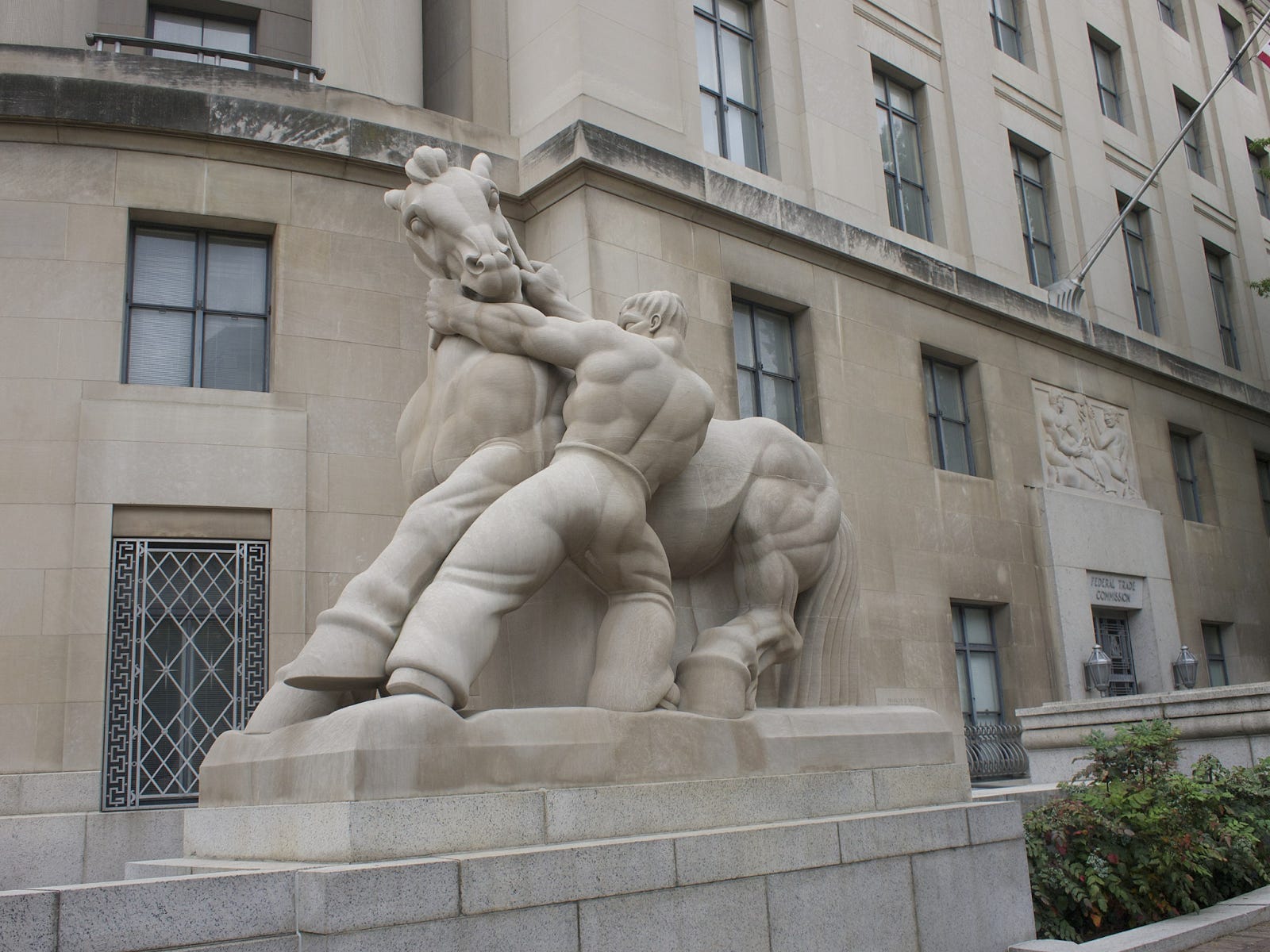
Dual enforcement is incredibly expensive and offers little in return to American consumers. It’s THE sacred cow of antitrust institutions. Now is a good time to end it. If this happens I call dibs on the Man Controlling Trade sculpture. It will make a heck of a water fountain.
#2 The FTC Should Use In House Economics Experts Rather than Academics and Consulting Experts
The FTC employs about 80 Ph.D. Economists. The economic analysis unit at the FTC is among the very best in the business, perhaps only rivaled by the Fed in terms of talent depending upon who you ask. By all accounts, they are a talented bunch with a wide set of skills.
The FTC asks those economists to do a number of things – including to do analytical work to support its cases. Yet, when it is time to hire an expert witness to develop and present those analyses in court – the FTC consistently goes with high-priced academic experts and consultants at the large litigation consulting shops. This is not a new problem.
I recall raising this during my days as a Commissioner (2013-15) and being told by FTC competition lawyers that the economic staff weren’t “as good” as the outside consultants or did not have experience on the stand. The first criticism was nonsense. The second is not a very satisfactory answer for an agency that will be a repeat player in antitrust adjudication. “Let’s train them instead!” I said. The response to my proposal ranged from crickets to sounds of appreciation that I was only a minority Commissioner. But it remains a pretty good idea. And for an agency that constantly complains about the size of its budget – like the FTC – it is a great idea.
How much would it matter? In an audit by the Office of the Inspector General back in 2019, the OIG identified the problem and faulted the FTC for failing to even consider internal witnesses and noted the rising share of the FTC budget attributable to expert witness costs, about $15 million by FY 2018.
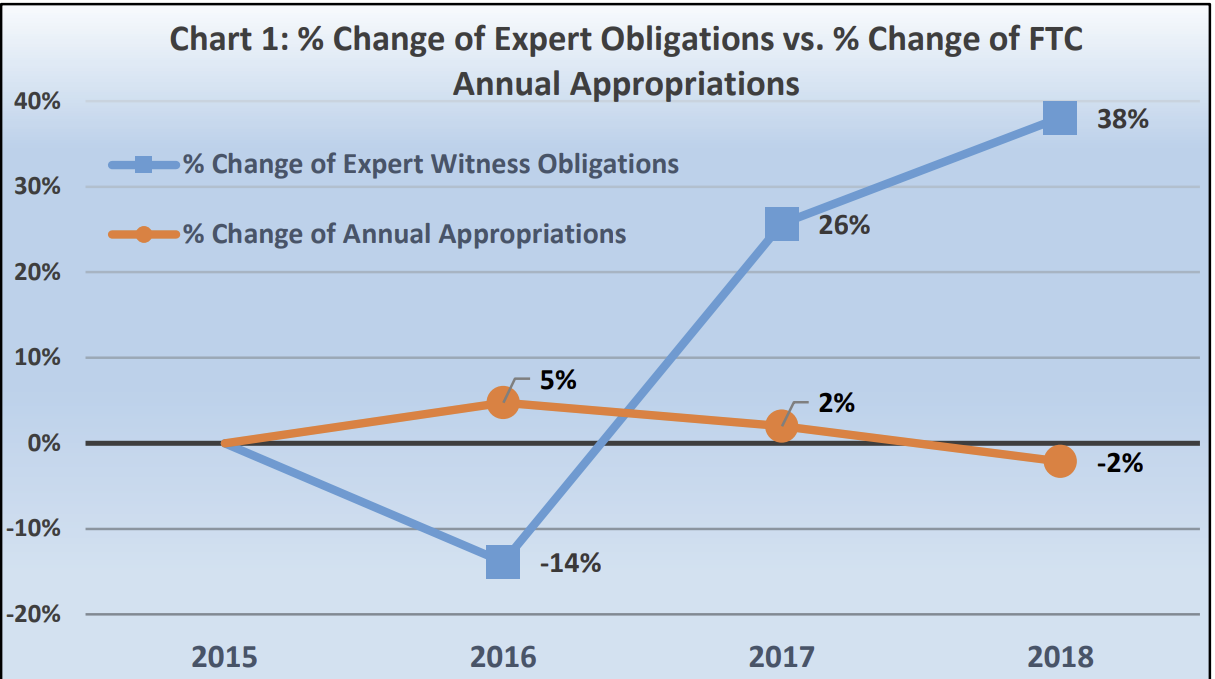
What is it now? Up to approximately $40 million in FY 2023, down a bit to $31.3 million in FY 2024, and back up with a request of an additional $15 million to fund expert witnesses in FY 2025.
The FTC attributes this rise in expenditure (and the budget need) to increased activity level and complexity of antitrust litigation. However, this is a trend that predates the Khan FTC. And it is a problem that many FTCs (Republican and Democrat) have missed because it requires the FTC to go to court without the biggest, shiniest academic name on its side. Who cares? You want to know who the FTC called as its expert when it won its merger challenge against Tapestry / Capri? FTC alum Loren Smith. What about its big merger challenge against Kroger / Albertsons? Dr. Nicholas Hill – you guessed it, FTC alum. The talent is there. It just leaves. This is a familiar dynamic for the FTC on the lawyer’s side of the house. The FTC is a training ground for talented young lawyers who often leave to private practice. That’s OK. Successful outcomes attract the next generation of talent. Recruiting and training a handful of economists to testify would save the FTC – an agency with an embarrassment of riches inside the Bureau of Economics — a ton of money that it could divert to other uses to promote the mission.
#3 Get Rid of the FTC Office of International Affairs
The FTC has an Office of International Affairs (OIA). It should not. The OIA’s mission is to “work[] with competition and consumer protection agencies around the world to promote cooperation and convergence toward best practices.” The DOJ has an International Section whose job is to bring “greater cooperation and convergence to international antitrust enforcement.” Don’t get me wrong – international competition advocacy is incredibly important. I’ve said before that “fixing” the messaging from US agencies to those around the world is an important thing that the Trump administration can do once in power. And that is true. But it is very difficult to send a uniform message with two competition agencies that very often have differing views because of their different structures.
What is the view of the United States when it comes to antitrust law and competition policy? It is the view of the Executive. The view of the majority of Federal Trade Commissioners – no matter the party – is not the view of the United States. And there is substantial reason to believe the two may differ. The view of the Federal Trade Commission on matters of competition policy is different today than it will be on January 20, 2025 or soon thereafter. The view of the FTC and the DOJ will likely be different on January 20, 2025 but brought into alignment once a Republican majority takes over at the Commission. But that could change if a Commissioner has a change of heart. This is no way to conduct international antitrust discussions. The United States should speak with one voice – and it should be the DOJs so that the message may align with White House priorities.
Lina Khan’s FTC infamously forced the resignation of its long-time director, Randy Tritell for what reports describe as “taking issue with her management style.” But the objection here is not about personnel. An FTC OIA is a bad idea no matter who runs it. Having two large groups of lawyers competing to speak for the United States on matters of international competition advocacy does not make sense in the modern environment. It is hard to track down exactly how many people work there. I think the number is around 30-40 lawyers along with additional supporting staff. Perhaps it has grown.
But this is an obvious candidate for DOGE-ification.
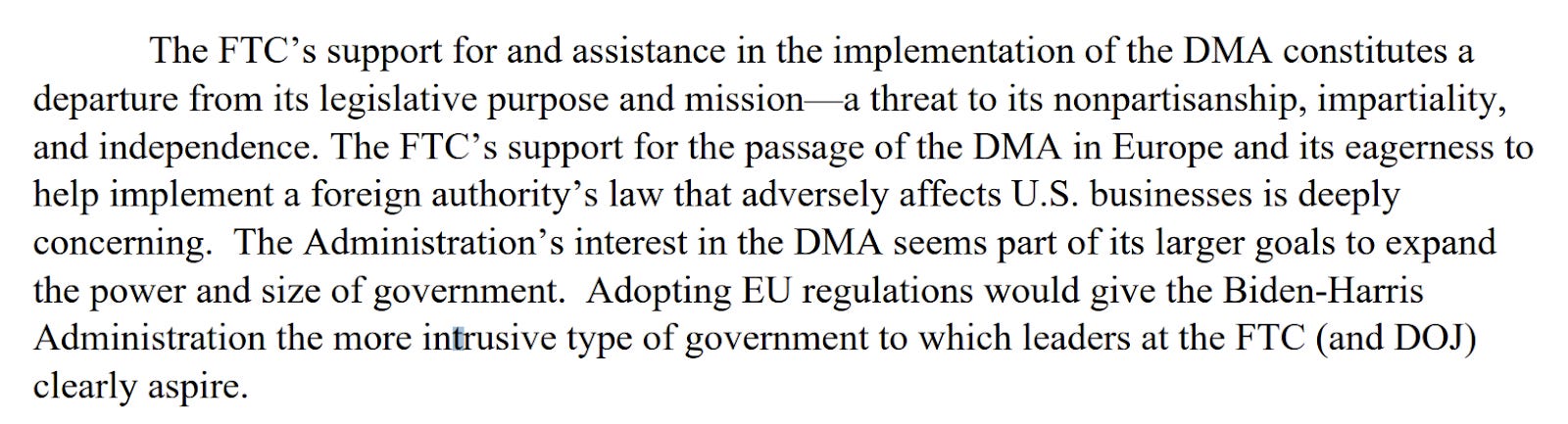
If that is not enough to persuade you – consider the House Committee on Oversight and Accountability Report that documents FTC OIA resources – that is, American taxpayer dollars – deployed to assist in the implementation of EU regulations targeting successful American companies. Not to “understand” the Digital Markets Act and other EU regulations targeting American companies. Not to study the DMA. But to “assist with the implementation of.” Here’s an excerpt from the Report:
The House Report also details coordination between the FTC’s OIA and EU enforcers on both Illumina-GRAIL and Amazon-iRobot transactions. Just for example:
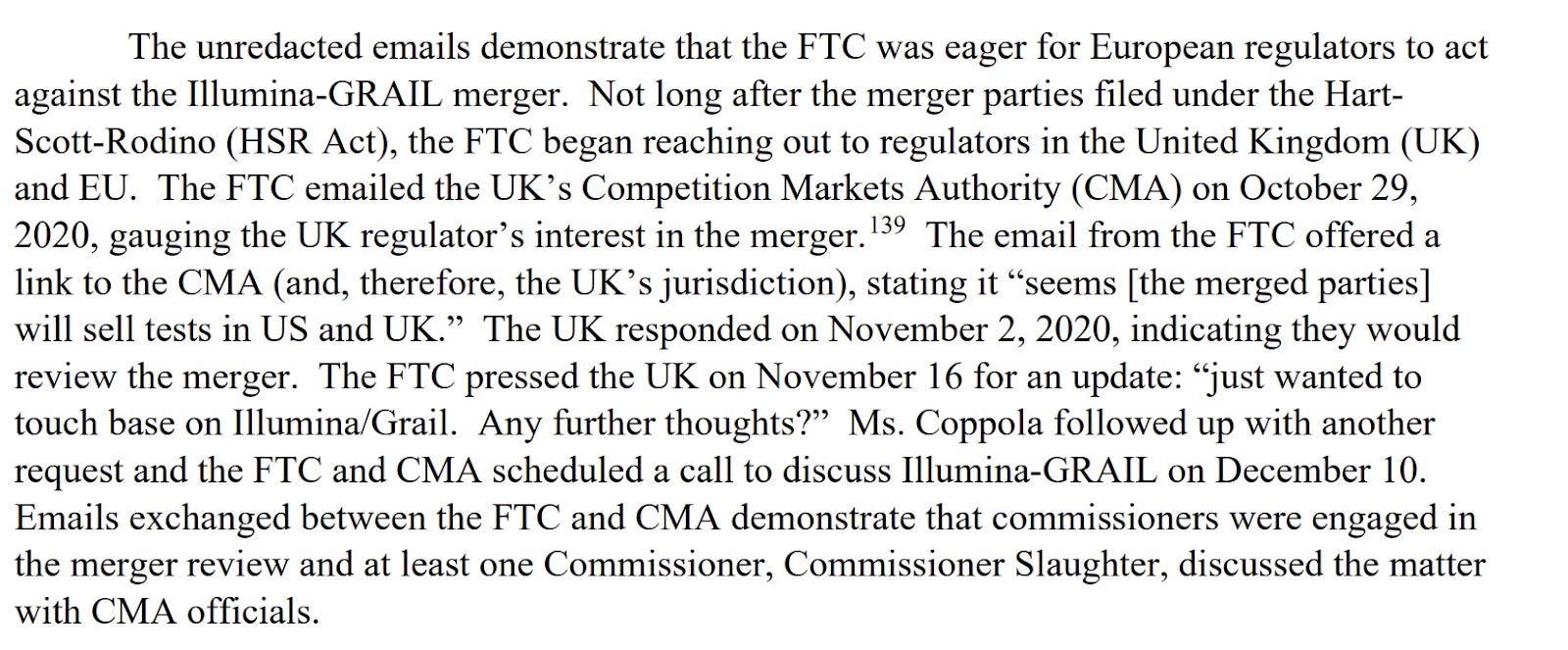
Cooperation between international antitrust authorities is relatively standard business. Cooperation to circumvent American antitrust law to assist European regulators in targeting American firms is not. The DOJ Antitrust Division should be the sole voice of the United States when it comes to global antitrust. That is not to say I love what the DOJ has been saying about antitrust internationally either – but that is a column for a separate day.
Wrapping Up
I’ve tried to stay policy neutral on these recommendations. That is, I’ve left out some of my favorite ideas that fall more into policy recommendations than streamlining the agency or cutting wasteful expenditures. For example, Robinson-Patman Act enforcement is detrimental both to competition and to consumers and it is antithetical to the FTC’s mission to spend taxpayer dollars to make them worse off. Or the FTC could stop wasting resources on competition rulemaking when it plainly does not have the authority. But obviously the Biden Administration does not take that view. So I’ve tried to keep this list focused on items that cut waste out of the budget with a positive (or at least, non-negative) impact on performance.
The FTC has three signature, unique characteristics that distinguish it from the DOJ: Section 5 Unfair Methods of Competition authority, administrative adjudication, and its Section 6(b) authority to do studies and write reports. The FTC has engaged in well known abuse of the first two of those signature authorities for decades upon decades. The Biden Administration found some new abuses — including using 6(b) studies as a political weapon while lowering their quality.
The solution? The One Agency Act – including limiting FCC authority over mergers – is an idea whose time has come. And it overlaps with DOGE priorities perfectly. Americans do not need to accept “it is too late to fix the problem now,” or “it is a historical accident” as reasons why taxpayer dollars are wasted in the name of overlapping and redundant antitrust enforcement.
If we are aiming for singles and doubles rather than home runs, there are plenty of ways to make the FTC more efficient. Between dramatically increasing the use of in-house economic expert witnesses ($30-50 million per year) and leaving international competition advocacy to the Department of Justice rather than the FTC, we are talking about reducing a substantial fraction of the FTC’s overall budget ($425 million). $50 million here, $50 million there and pretty soon it begins to add up to real money.
Happy Thanksgiving to all of you!
And always, subscribe, upgrade to a paid subscription, and tell your friends. See you next week.
Josh -- there are some good ideas in your post -- but the idea that the FTC can substitute BE experts for outside experts is not one of them. BE does provide some experts -- always has. And a substantial amount of lit support - always has. But its ability to substantially increase either of these is very limited.
1. BE has 80 PhD economists -- true. One-third of them are consumer protection specialists. Do they know anything about antitrust? No. Can't use them as experts in an antitrust proceeding.
2. Of the remaining 50 or so antitrust economists, a large number of these are GS 12s and 13s. In other words, newbies. Are they qualified to testify as "experts"? No. They would be devoured on cross-examination. They might even be disqualified by the court as they really aren't experts (at least not yet).
3. As to the senior economists: they have to volunteer to testify (believe it or not, at least two Commissioners (Slaughter & Khan) did not understand this - they thought BE could compel its economists to testify. It took a memorandum from the BC AD for Litigation to explain that when the FTC presents an expert to the court, the idea is that the expert independently arrived at his/her conclusions. So, sorry ladies, no compulsory testimony).
A lot of people don't want to testify -- it's grueling, high pressure work that pays much, much better on the outside. Only a handful of people are tempermentally suited for it. I'm was always shocked that any BE staffer would do it (human capital investment maybe?). That's why people like NIck Hill and Loren Smith now work for consulting firms.
3. Opportunity cost: expert testimony (and the vast pyramid of support personnel on whom the expert relies) consume a lot of work-hours. Who's going to staff the ongoing investigations when the staff is tied up in lit support? Even if you have a BE testifying expert, you probably are going to have to hire at least some consultants for support work. And that's where a lot of the costs are incurred.
Great ideas. But you are apparently taking DOGE a lot more seriously than I. As long as we're looking at the FTC, any thoughts about merging the Consumer Financial Protection Bureau and the FTC's Bureau of Consumer Protection?