

I’m a big fan of the “What If” genre. You know, like the Marvel Universe. What if Captain America was the First Avenger? What if Thor was an Only Child? What if Strange Supreme Intervened? Not a Marvel fan? OK fine. Red Dawn? Back to the Future? Imagining up and thinking through counterfactuals and hypothetical scenarios can be fun and entertaining. It can also be pretty informative.

So, today’s Competition on the Merits is a What If scenario that has captivated the minds of many who follow the administrative state, just the FTC, or even just competition policy: What if Lina Khan Refuses to Resign by January 20th?
To be clear, my money is on Chairwoman Khan resigning. I suspect she will use the lame duck period to get any remaining cases out. COTM readers know that I’ve been predicting the FTC will bring some Robinson-Patman Act cases before she leaves, for example. Perhaps there is a remaining rule or two or other matters she would like to have filed before she goes. One major difference between the FTC and DOJ is that it is harder to “undo” matters after a chance in administration. Any 3-2 matter voted out during the lame duck faces an FTC gridlocked at 2-2 after Khan’s resignation. Antitrust readers may remember the FTC’s Qualcomm matter getting stuck in an awkward 2-2 purgatory after Trump’s first election win, resulting in no real way to end the suit despite the administration’s preferences. There are many other examples. But the point is that lame duck FTC matters can have a longer shelf life than those at the DOJ.
But beyond getting a handful of new cases out – what else is there for Chairwoman Khan to do? She’ll have tried a competition rule, brought (or continued) cases against Amazon, Microsoft, Meta, Walmart, the oil and gas industry, private equity, and just about everyone else. Even if she stays through inauguration day, she does have to leave when her successor is confirmed. That day will come before the end of those various lawsuits. So why not go back to Columbia and watch the results come in rather than stay and take a demotion to Commissioner from Chair?
So I do think Khan leaves. But I do not know that. And the possibility of her digging in and staying has excited her fans and supporters as well as administrative law geeks.
First her fans:
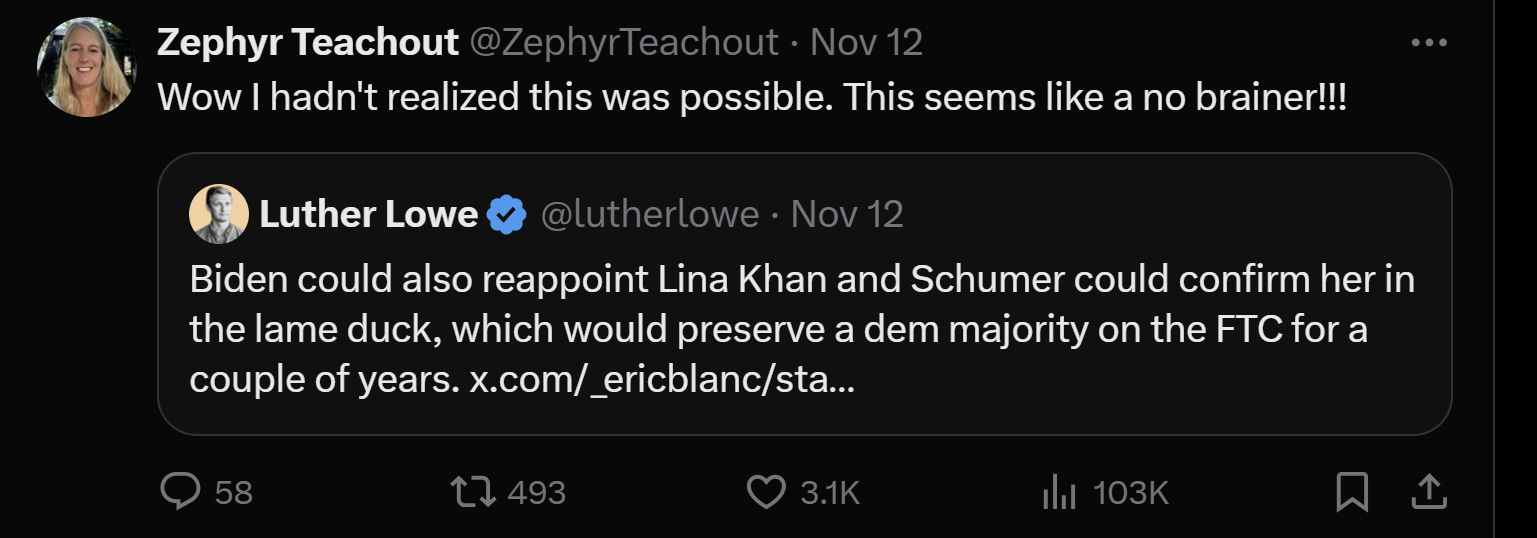
Now, these fans have a particular strategy in mind: President Biden renominating and confirming Khan to a brand new term before January 20th. This was never going to work. But it is important for our purposes to understand that Khan is sitting in an expired term, i.e. the moment her successor is confirmed she is out of the seat.
Some also had the notion that Trump might renominate Khan because JD Vance said some nice things about her. That also was never going to happen.
The softer version of the strategy to stay and deprive the Trump Administration of its majority would be to simply refuse to resign by January 20th. The norm at most independent agencies is for the Chairman to do exactly that upon a change of administration. This is how it has happened at the FTC, historically. Same for the FCC and SEC, among others. But there was certainly a lot of interest and support for the idea that Lina Khan could just holdout, dig in to her position, and retain the Demoncratic 3-2 majority at the Commission for as long as possible. Again, we’ve established that “as long as possible” is limited to how quickly the Trump Administration could vet, nominate, and confirm a new Commissioner for her seat (or a new Chair). But that process takes time. We are talking 4-6 months at the earliest. And that is a lot of time to block mergers, bring lawsuits, and continue the Biden Administration control of President Trump’s FTC.
Of course, the other side of the debate had a clear position as well:
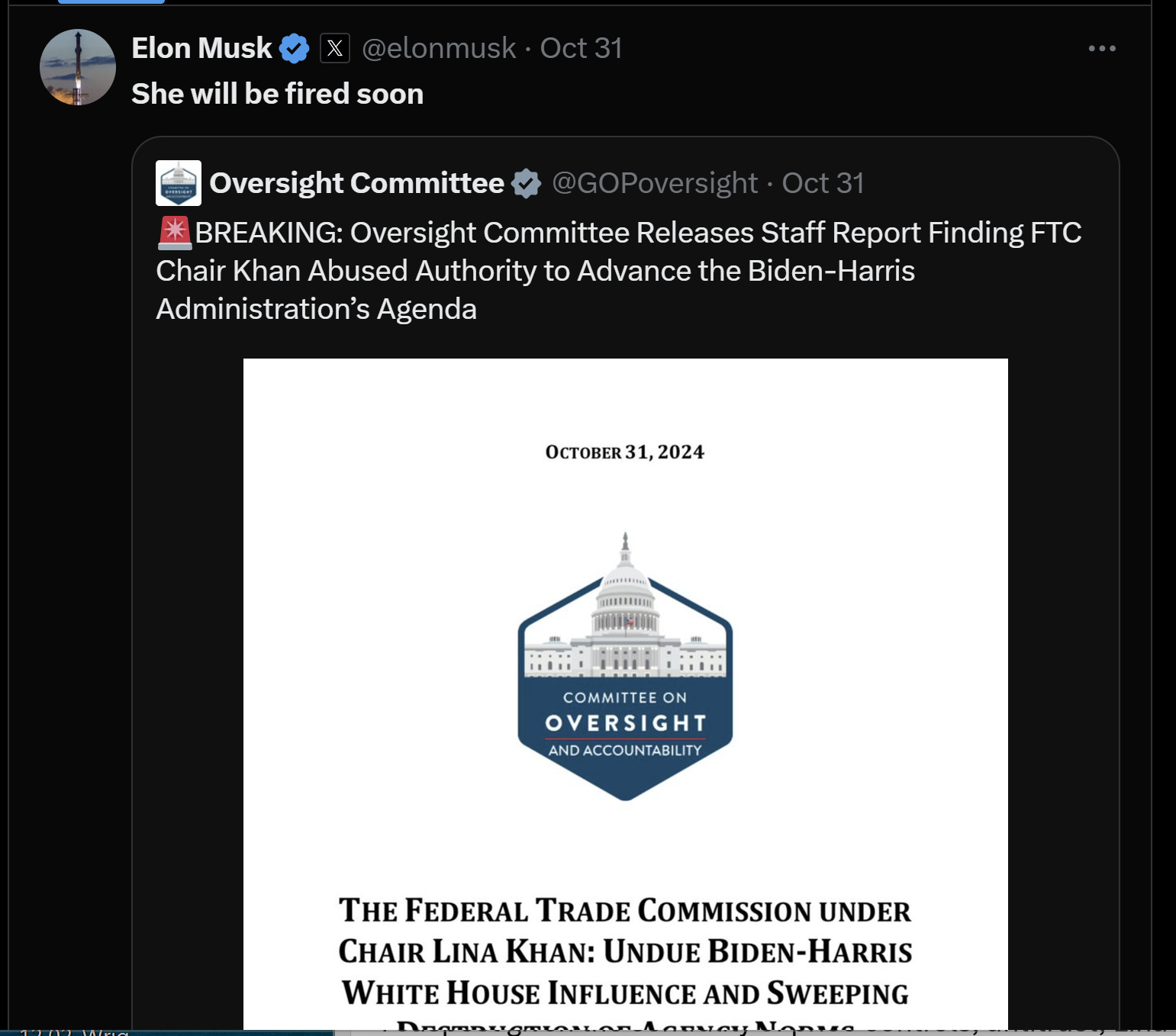
Fair enough. And I suspect Mr. Musk gets his way here. So that brings us to our “What If” scenario. Here are the assumptions:
President Trump wants Lina Khan gone and out of the FTC
Lina Khan refuses to resign by January 20th
Lina Khan is sitting in an expired Commission seat, and so can also be replaced by nominating and confirming her successor
What happens next? What if Lina Khan refuses to resign?
How to Fire an FTC Commissioner Who Will Not Resign
The general rule is, of course, that the President can fire any executive officer. Article II vests the entire executive authority within the President and contemplates the President delegating to and relying upon various officers and administrative officials to carry out that authority. The Court has long affirmed the President’s removal power as a corollary of the President’s authority granted under Article II to “take care that the laws be faithfully executed.”
The Court has recognized only two exceptions to the President’s removal power. The first involves officers of independent, multi-member Commissions, who carry about only quasi-legislative or quasi-judicial powers. The second involves so-called inferior officers whose exercise of authority may not interfere with the President’s duties. Were Lina Khan at some other executive agency – there would be no question about the President’s ability to remove her on January 20th. Because the FTC is a multi-member Commission – indeed, the very multi-member Commission the Court analyzed in Humphrey’s Executor back in 1935 when finding some removal protection was constitutionally permissible – there is some question about the President’s removal powers in that context. Let’s start there.
First, the FTC Act itself contemplates that a Commissioner “may be removed by the President for inefficiency, neglect of duty, or malfeasance in office.” Let’s call this “for cause” firing.
The second route is more complicated – but interesting as a matter of administrative law. In Humphrey’s Executor v. United States, the Supreme Court greased the tracks for the modern administrative state by holding that President Roosevelt’s removal of Commissioner Humphrey without cause violated the FTC Act. This is not the place for a treatise on political independence of the so-called “independent agencies,” but the concept is a controversial one. As agencies like the FTC work in tandem with the executive on things like Executive Orders, agency rulemaking, and even are seen out and about doing political campaigning – the fig leaf of independence has become smaller and smaller over time.
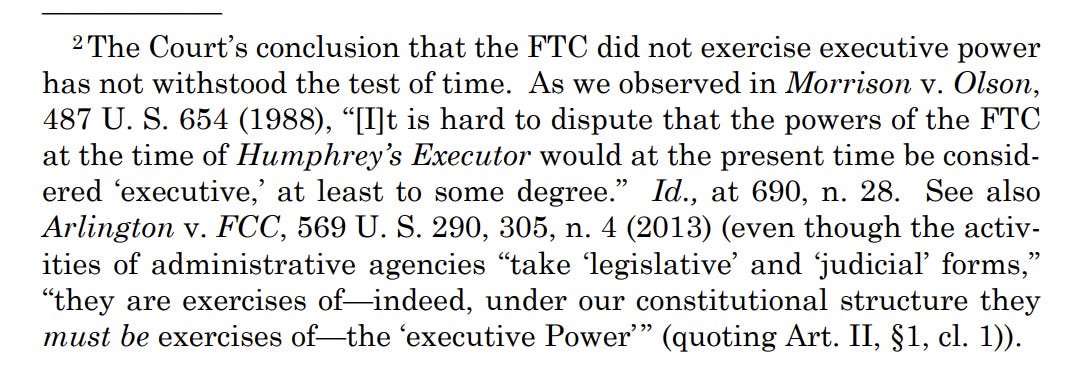
On top of that, Humphrey’s Executor as precedent has long been thought questionable by commentators and administrative law scholars. The rationale in Humphrey’s Executor to insulate the FTC from terminations without cause was that the FTC was “neither political nor executive,” and it merely carried out quasi-legislative functions. The FTC (or so the Court thought) acted with “entire impartiality.” It did not do things, so the Court held in 1935, that made it walk and talk like an executive agency. Fast forward to the modern FTC and it is very difficult to square it with the FTC the Supremes were discussing in 1935. The Supreme Court in Seila Law v. CFPB recognized the shift and expressed willingness to revisit Humphrey’s Executor.
Justice Gorsuch described Humphrey’s as “a direct threat to our constitutional structure.” It has become almost standard practice in FTC antitrust litigation, including merger challenges, to include as affirmative defenses arguments that the FTC’s structure is unconstitutional due to inability to remove the Chairman as well as features of its administrative litigation process.
There is a lot going on there. And again, not the place for a treatise. If indeed Chairwoman Khan decides to stay beyond January 20th we will have plenty of time to write about this. But the basics dynamics are pretty clear enough for now. To review:
President Trump could try to fire Lina Khan “ for cause” as contemplated by the FTC Act; this route is probably harder as one needs to demonstrate cause in the form of “inefficiency, neglect of duty, or malfeasance in office.” The cases say mere political disagreements are not sufficient for cause.
There is also the possibility of an assertion of removal power without cause. This argument would fly under the flag of asking the Court to revisit the question left in footnote 2 in Seila Law – that is, does the 2025 FTC exercise executive powers? Conservatives who would like to bring administrative agencies to heel have long targeted Humphrey’s and would be anxious to litigate over it.
So there are two paths to a termination. Both would result in litigation over whether the statutory requirements for cause were satisfied or whether Humphrey’s Executor protects Chairwoman Khan from termination. Or both in the same litigation. The latter obviously would require the Supreme Court to take the question. I think we have painted the landscape – so what actually would happen? What would it look like? Here is my best shot at the question.
What Happens on January 20th if Lina Khan Refuses to Resign?
Let’s presume we hit Friday, January 17th without a resignation. What happens next? I suspect that wheels start turning to implement a plan to fire Chairwoman Khan as quickly as possible. If Chairwoman Khan stays beyond January 20th, after all, the Biden FTC remains in control with a 3-2 majority for as long as she stays. And if this “What If” scenario – the Trump Administration wants her out as soon as possible. (Which I think is correct)
What is the plan? Again, if come Monday morning on January 20th, Lina Khan has not resigned, what will the Administration do? The Administration will force the issue. I would expect the Trump Administration to fire her without notice on Day 1 of the Administration in order to set up the Humphrey’s Executor challenge. What does that look like? The Administration would seize her laptop, remove her IT credentials like any other termination, and escort her out of the FTC building (if she is there in person).
The next part is what is interesting. Remember, in our What If scenario, the Trump Administration wants her out, but Lina Khan wants to stay. Now fired, Ms. Khan files a lawsuit asserting two arguments: (1) the President does not have authority to fire her “for cause” because the statutory requirements are not met; and (2) Humphrey’s Executor protects her from firing without cause.
Litigation over the second question is what many conservatives who would like to reduce the size and scope of the administrative state would like to see. Humphrey’s Executor is an important symbol in the fight over executive control of the administrative state. Whether its practical importance is as large as its symbolic importance is a discussion for another day. For example, even without removal protections, both Congress and the President have a number of levers with which to exert control over the FTC. But let’s put that aside for the moment.
What happens after the lawsuit? The FTC is down to 2-2 with Lina Khan fired. I presume the lawsuit would involve some sort of plea for injunctive relief for Ms. Khan to stay in her job pending the outcome of the suit. I doubt this would be granted. But it raises some interesting questions. A much faster method to remove Lina Khan from the FTC than overturning Humphrey’s Executor through litigation would be to simply nominate and confirm her successor. That might take months — but would likely be more efficient. The point of the more inefficient path would be to win twice: remove Lina Khan and topple Humphrey’s Executor.
Would the Trump Administration attempt to terminate only “without cause” to set up the Humphrey’s Executor challenge or would they include a “for cause” termination rationale? The latter would possibly give a way out of a court addressing Humphrey’s Executor. And it is not implausible that a for cause termination case could be made out. The House Report lays out a variety of evidence concerning malfeasance at the Federal Trade Commission ranging from collusion with European regulators targeting American firms to conflicts to using agency resources to campaign on behalf of President Biden. And Competition on the Merits readers will recall the FTC staff surveys during Lina Khan’s leadership that consistently questioned the integrity of her leadership. For cause terminations cannot just involve “political disagreements,” but there is more than enough here for a plausible case.
It is also important to remember that Lina Khan can moot the lawsuit any time by resigning. The question really is what does Lina Khan want? We’ve presumed for this exercise that she wants to stay. But why would she? One reason is that staying only to be fired by President Trump might produce a sort of martyrdom effect for her (a la Sally Yates). Perhaps going down in a blaze of glory puts Khan on a fast track to bigger and better positions when the Democrats next hold the White House. Perhaps. Perhaps not. I think she is probably already on those lists. But there is a large downside to this approach. The inevitable outcome of the lawsuit is that the Supreme Court reverses Humphrey’s Executor. The writing has been on the wall for some time. This will be a major win for conservatives against the administrative state. I’m not sure that it is something that Ms. Khan would like to facilitate. On the other hand, thinking on the left about the relationship between executive power and the administrative agencies is also changing. It was under the Biden Administration, after all, that the FTC behaved most like an agency under the control of the executive branch.
There are more questions than answers here. But they are the sort of questions both the Trump Administration and, I presume, Lina Khan should be thinking about in the days between now and January 20th. So what happens if Lina Khan stays? My best guess at an answer is that she gets fired on January 20th and we see a lawsuit in which either Humphrey’s Executor is overturned or she is found in neglect of duty. Neither of these are good outcomes for Chairwoman Khan, even in exchange for martyr treatment by the political left. The biggest downside for the Trump Administration is that confirming Khan’s successor automatically moots any such lawsuit – and so one can have a shot at overturning Humphrey’s Executor or an efficient path to a 3-2 FTC majority, but not both.
Stepping out of the “What If” metaverse for a moment – I suspect that we will actually see something a bit more mundane. The most likely outcome is that Chairwoman Khan will announce her resignation after a few more major initiatives and lawsuits are off of her plate. I suspect she will announce a resignation date of January 20th or within a few weeks of that date and, if so, the Humphrey’s Executor showdown over executive control of independent agencies never comes to fruition. The Trump Administration will name one of the sitting Republicans, Andrew Ferguson or Melissa Holyoak, as Acting or Permanent Chairman. The President will move on to confirming a new Republican Commissioner and taking majority control of the FTC. Chairwoman Khan will resign, take a break, perhaps head back to Columbia Law School and watch the results of her various agenda items roll in from the courts.
But I might be wrong! As the great philosopher Yogi Berra said, “Prediction is hard, especially when it is about the future.” See you soon.
Don’t forget to subscribe, upgrade to paid, or gift a subscription for the holiday season!